Monday, April 7, 2014

Essay 5—Resurrection—(2) The End of All Things

Outline: 028-E5.2-Resurrection-End of All Things
Passage: 1 Corinthians 15:21-28
Discussion Audio (1h21m)

The Resurrection is the gospel.
Everything else is secondary.

Paul continues the discussion of the centrality of Christ’s bodily Resurrection, witnessed by hundreds of human eyes, to Christianity. It is the one event that distinguishes Christianity from all other belief systems and philosophies. Many martyrs have died. But only one has risen. Death does not define Christianity. Life does.

For Paul, the Time of the End begins with Christ’s resurrection. It assures him that Death has been defeated and it is in the process of being destroyed, along with all earthly rule, powers, and authorities. When Christ returns, the destruction of death will be complete, never to return. The resurrection of all who have died “in Christ” is its visible proof that death has given up its dead.

Readers need to be careful to note that Paul does not address the question of what happens to those who have died prior to Christ, or who have died without knowing Christ. His audience is the Corinthian believers who hold in common the knowledge about and resurrection of Christ. To use this passage to teach that only those who are Christians will be saved misses the point.

It must be noted at the outset that the general resurrection of the dead is not Paul's concern, neither here nor elsewhere in the argument.[1]

Another point to note is that Paul’s focus is not eschatological chronology, but the logical process of eschatology. In other words, the Christ’s resurrection as the firstfruit logically guarantees that all who have died in Christ must be resurrected. And the resurrection of believers is logical proof that death and all powers logically resulting from death have been destroyed.

The crucifixion of Christ shows the power of sin and death. If it ended there, sin and death could claim victory over God, life, and love. That’s why the resurrection, and not the cross, is the center of Christianity. That’s why the resurrection, and not the cross, is the focus of the gospel. The resurrection is the power of God at work to destroy sin and death.

Paul is thereby saying to his readers, “If Christ is not raised, then this vision of the end of all things is a lie. But Christ is raised, and we the apostles have seen him. If you deny him as the reigning Lord, you are the losers.”[2]

The Resurrection is about more than just Easter.

Christians and Christian Churches should perhaps consider focusing more on the Resurrection and less on the Cross. The Christian faith should focus more on life and less on death. Easter should be celebrated far more often than just on Easter Sunday.

This is one of the great passages in the NT… in terms of the true significance of Easter. It is therefore unfortunate that at times this powerful demonstration of the certainty of our own resurrection is overlooked in favor of an apologetic of trying to prove the resurrection to unbelievers. First of all, that is not what Paul is trying to do. What he has going for him is the common ground of their common faith in the resurrection of Christ. There is a place for apologetics, that is, the defense of Christianity to the unconverted; but Easter is not that place. Easter, which should be celebrated more frequently in the church, and not just at the Easter season, calls for our reaffirming the faith to the converted. The resurrection of Christ has determined our existence for all time and eternity. We do not merely live out our length of days and then have the hope of resurrection as an addendum; rather, as Paul makes plain in this passage, Christ's resurrection has set in motion a chain of inexorable events that absolutely determines our present and our future.[3]


[1] New International Commentary on the New Testament: The First Epistle, entry for 15:21-22.

[2] Bailey, location 5289.

[3] NICNT, entry for 15:28.

Wednesday, April 2, 2014

Essay 5—Resurrection—(1) Message and Validity of Faith

Outline: 027-E5.1-Resurrection-Faith
Passage: 1 Corinthians 15:1-20
Discussion Audio (1h14m)

Without the bodily resurrection of Jesus,
nothing else in Christianity makes sense --
Not even the Cross.

Paul is addressing yet another problem and misunderstanding within the Christian believers of Corinth. Partly based on their disdain for the physical body (body-spirit dualism from Greek philosophy) they accepted the idea of a resurrection, but rejected a resurrection into a physical body. And possibly based on their overrealized eschatology, they may have believed that they were already “spiritually resurrected” with their baptism.

This is a passage that modern English readers can misinterpret due to our assumption that “how can some of you say that there is no resurrection of the dead?” (15:12b) means that there is no resurrection at all. But that is not what the Corinthians meant and not what Paul would have heard. What they meant was that “there is no bodily, physical resurrection of the dead.” The Corinthians still believed in at least the concept of a resurrection and some kind of existence after death. It is the nature of the resurrection and existence that was in question.

Paul’s first defense of the bodily resurrection is that all the apostles teach it. He reminds the Corinthians that when he first came to them, this is the gospel that he taught them and that one that they accepted and believed.

His second defense of the bodily resurrection is that if it is not true, then nothing about Christianity is true, because it all rises or falls on the veracity of the hundreds of witness accounts of the bodily resurrection of Jesus.

Here is another mistake modern Christians make with this passage. It is used as an apologetics for the resurrection against unbelievers. That is not the point of this passage. Paul writes with the assumption that there is a resurrection. He does not try to prove it. His argument is with the nature of the resurrection.

… Paul will next turn to a direct confrontation with the Corinthians over their denial of the resurrection of the dead. The nature of that argument makes it plain that the purpose of this opening paragraph is not to prove Christ’s resurrection but to reestablish that fundamental premise as the common denominator from which to argue with them… The reason for the catalogue of witnesses is therefore not to prove that Jesus rose but to emphasize that the resurrection of Christ, which they believed, had objective reality…

On the other hand, there are those who use this passage to try to prove the Resurrection to unbelievers. What they fail to recognize is that such “proofs” are valid only to those who believe.[1]

Paul explains the “essential” of the gospel in 15:3b-5a. It is the death, burial, resurrection of Jesus and the many witnesses to the events. The focus of the gospel is the resurrection, not the death. The focus of the gospel is not payment for sins, punishment for sins, or satisfying the “wrath of God,” but in the power of God to overcome and destroy the power of Sin, i.e., Death.

(See my previous post on why Paul does not teach the penal-substitution theory of the atonement.)

Kenneth Bailey writes:

This is another case where the third-party substitutionary theory of the atonement, with its focus on penalty, can lead astray. Imagine a scenario in which God takes Jesus to heaven seconds after the great cry, “It is finished.” Had that happened, would there be any salvation for believers? If the focus is on penalty, then of course there is salvation because “Jesus paid it all…” Does that not mean that the great work of salvation is completed? Not for Paul. For him, without the resurrection all faith is futile and believers are still in their sins. As noted, the central focus is rescue, not penalty. Without the resurrection the death of Jesus is like the death of John the Baptist. If there is no resurrection, Jesus is one more rabbi who tried to renew Israel and failed…

The resurrection affirms that sin and death do not have the last word. At the cross the finest religion of the ancient world (Judaism), and the finest system of justice of the ancient world (Rome), joined to torture this good man to death. These were not evil forces. They were the best institutions the ancient world had to offer, and yet together they produced the cross. But that was not the end. After the cross came the victory of resurrection…[2]

Rev. Russell Rathbun writes in his lectionary discussion on Lazarus’ resurrection (“When Resurrections Go Bad,” posted March 30, 2014; John 11:1-45):

The core of the Christian faith is the proclamation that, Christ has risen. It is way different when Jesus does it. Jesus defeats death—death no longer has power. Jesus ushers in the fullness of life for all. Jesus returns from the dead not to punish his murderers, but to redeem them. Jesus’ resurrection brings a new life. This is the gospel. [Emphasis mine.]

I’ve often felt that too much of modern Christianity is obsessed with the death of Christ, with sins, with the so-called payment for sins, with satisfying some kind of demand placed by the wrath of God, with hell and punishment. First Corinthians 15 and Paul’s writings should be seen in their proper light. The gospel is not about the cross, but about the resurrection. It is not about death, but victory over death. Humankind, fallen under the power of Sin and Death, killed Jesus, and tried to kill God. But the good news – the gospel – is that the power of God is greater than the power of Sin. The resurrection is proof of that power.


[1] New International Commentary on the New Testament: The First Epistle, entry for 1 Cor. 15:11.

[2] Bailey, Paul Through Mediterranean Eyes, location 5203-5212.

Tuesday, March 25, 2014

Christus Victor in 1 Corinthians 15

What did Paul mean when he wrote, “Christ died for our sins”? [1 Cor. 15:3; italics supplied.] This is part of our study for this Saturday (March 29). As a preview, this is a little of what Ken Bailey writes in Paul Through Mediterranean Eyes.[1]

“Christ died because of our sins” is the preferred (legitimate) Arabic translation of this text…

Theologian Miroslav Volf has written,

“Let us beware that some accounts of what it means for Christ to have died on behalf of the ungodly—what theologians sometimes call his “substitutionary” death—are deeply problematic. If we view Christ on the cross as a third party being punished for the sins of transgressors, we have widely missed the mark…”

William Temple points out that the New Testament always starts with the love of God, not his wrath. He writes,

“… So the forgiveness that Christ wins for us is not chiefly a remission of penalty; it is the restoration to the affectionate intimacy of sons with their Father…”

God is angry at sin, but, as Temple argues,

“[God’s anger] is not anger, if by anger we mean the emotional reaction of an offended self-concern; it is anger, if by anger we mean the resolute and relentless opposition of a will set on righteousness against a will directed elsewhere… He seeks to abolish sinners by winning them out of their sin into the loyalty and love of children in their Father’s home… It is only through preoccupation with thoughts of punishment that people have come to invent doctrines of transferred penalty…”

Suffering is the divine choice in which we participate. Temple writes,

“There are two ways of expressing antagonism to sin; one is to inflict suffering on the sinner, the other is to endure suffering…”

The issue is the reform of the sinner. Temple concludes,

“Fear of punishment might deter me from sinful action, but it could not change my sinful desires… But to realize what my selfishness means to the Father who loves me with a love such as Christ reveals, fills me with horror of the selfishness and calls out an answering love… We plead His Passion, not as a transferred penalty, but as an act of self-sacrifice which re-makes us in its own likeness.”

What Bailey describes by quoting Volf and Temple is Christus Victor – where the atonement is not about paying the penalty but about love transcending the demands of the law, and where love transforms wrath into grace and mercy, so that sinners may recognize and accept the power to transform into Christlikeness. The resurrection is the most vital part of the gospel because it is proof that love has conquered death and the grave.


[1] Bailey, locations 5118-5169.

Tuesday, March 11, 2014

Essay 4—Men and Women in Worship—(6,7) Silence During Worship

Outline: 026-E4.6-Silence During Worship
Passage: 1 Corinthians 14:26-40
Discussion Audio (1h04m)

Respect one another’s rights to
speak, listen, and learn during public worship.

The present passage includes verses that are sometimes pointed to as “proof” that women are to remain silent in church and, by inference, that they are not to take part in leading public worship (vv.34-35, 37). I found it an curious coincidence that discussion of this passage fell precisely on this year’s International Women’s Day, March 8, 2014.

There are many problems with using these verses to support the idea that women must maintain a lesser role in public worship. The first is that in the immediately preceding set of verses (vv.26-33), both the tongues-speaker and prophets are instructed to “remain silent” (v.28) or “be silent” (v.30) under certain conditions. The women are instructed to “keep silent” (v.34) as a third group in the series. The problem for modern interpreters is that Paul does not appear to provide any limiting circumstances in the text itself.

In our study we have already established that women did prophesy and lead in public worship (11:5). The second problem then is that Paul would appear to be contradicting himself if (vv.34-35) is interpreted as literal and universal.

A third problem is that in its context, what is frequently translated as “women” is, in this case, best translated as “wives.” This means that at the very least, unmarried women are not included in Paul’s instruction.

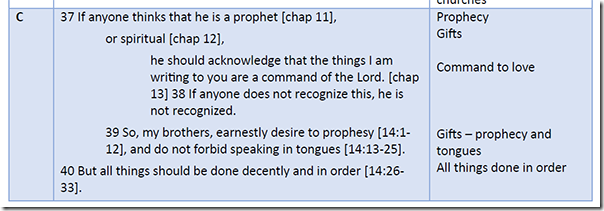
The final problem I note here is with the “command” Paul refers to in v.37. Frequently for those who wish to “prove” that Paul issued women’s silence in worship as a binding and universal command will point to this verse. On the surface it could be read as pointing back to its immediate antecedent, which is indeed the command to remain silent and ask their husbands at home. But when the entire rhetoric of vv.37-40 is viewed, the command most likely refers to the command that love be the context for all Christian activity that is found in chapter 13 (see diagram, from Bailey, location 4954).

image

The crux for interpreting, understanding, and applying this passage comes in v.33a, “For God is not a God of confusion but of peace.” This appears to be a hinge verse that summarizes why the gifts of tongues and prophecy must be employed in a controlled manner, such that in some cases silence is necessary. It also introduces that reason why Paul instructs wives to remain silent. The Christian wives in the Corinthian church were disrupting worship and causing confusion, preventing other worshipers from hearing and learning.

Kenneth Bailey provides, in great depth, a reconstruction of what he believes was happening in the Corinthian church, based upon his experiences among the present-day peoples of the area. This is found in Chapter 4.7, “Women and Men Worshiping: No Chatting in Church”, of Paul Through Mediterranean Eyes: Cultural Studies in 1 Corinthians. His line of thought, briefly, is thus:

  1. The Corinthian church was perhaps the most diverse in composition – including those fluent in Greek and those with just enough to get by
  2. Some of those speaking during worship may have had strong accents of a non-native Greek speaker – making understanding difficult for some hearers – thus they might inquire amongst themselves what they were hearing
  3. Due to their cultural upbringing, women were handicapped with a very short attention span, as short as fifteen seconds
  4. When they were not being directly addressed and/or didn’t understand what was being said, they would quickly begin chatting amongst themselves
  5. Men and women may have sat separately. If this was the case, wives may have shouted across the divide to their husbands to ask them to explain
  6. Therefore, the wives are instructed to respect the others in worship and remain silent and ask questions once at home
  7. In a predominantly oral culture, as soon as the speaker pauses the audience begins discussing the subject amongst themselves. It is particularly prominent in women’s gatherings. It is their way of learning and retaining information.
  8. Paul’s instruction is not that women should stop participating, speaking, and leading worship. Paul’s instruction is that they should keep quiet so that everyone is afforded the opportunity to hear what the speaker is saying.

C. H. Talbert, in Reading Corinthians, summarizing 1 Corinthians 11-14 writes:

On the one hand, the Corinthian spirituals contended that some gifts were better than others; indicated that they wanted the higher gifts; took the position that tongues were a sign for unbelievers, prophecy for believers; and held that women should not occupy a leadership role in Christian worship. On the other hand, the apostle argued that there are a variety of gifts and that each one makes its own contribution to the common good; showed love to be the indispensable motivation for the manifesting of any gift; insisted that understandable speech is mandatory in corporate worship for both believer and unbeliever; and stood firm for the principle that Christian corporate worship is not a male-dominated enterprise.[1]

Nowhere in 1 Corinthians does Paul give a universal command, applicable to all places, peoples and times, that women and men have different roles in the church.[2] Paul affirms the right of women to lead, speak, and teach the entire church during public worship.

To see it otherwise is terribly faulty and holds dire consequences for the integrity and health of the church. To maintain practices that divide the service of men and women in the church is, in effect, doing that which the Corinthians were being corrected by Paul – condoning and encouraging divisions, creating a class of people that were considered “more spiritual” by the nature of gifts. Paul would be appalled.

The message of this passage is clear and simple: When in public worship, respect one another. Show love by remaining silent when others are speaking so that those around you can listen and learn. Nothing more, nothing less.


[1] Reading the New Testament: Reading Corinthians, 1 Cor. 14:20-36, “Conclusion”.

[2] And I hasten to add that such instruction is not found in any of the remaining undisputed Pauline writings.

Tuesday, February 11, 2014

Essay 4—Men and Women in Worship—(5) Spiritual Gifts in the Body

Outline: 025-E4.5-Spiritual Gifts in the Body
Passage: 1 Corinthians 14:1-25
Discussion Audio (1h14m)

Public Worship Should be Inclusive and Participatory

Paul returns to the discussion of tongues and prophecy in the first half of chapter 14. It is easy to see the point of this section as the better value of prophecy over tongues. However, in the overall context of the entire essay and in particular the corresponding portion of the chiastic pair found in chapter 12, the thesis of this passage is around the appropriate use of spiritual gifts in public (corporate) worship. Tongues and prophecy happen to be the two examples that Paul picks up and uses in this passage because both involve speaking, and the Corinthian believers (at least some of them) considered one (tongues) more “spiritual” than all other gifts.

A couple of other questionable conclusions sometimes drawn from this passage are: 1) that this passage is defining the theology of the spiritual gift of tongues[1]; and 2) that tongues are less valuable, and possibly even bad/evil, because the use of tongues is selfish[2] and/or does not engage the mind.[3]

The most important contextual point to keep in mind during the reading and interpretation of this passage is that Paul’s parenesis is directed at what happens during public worship. Private devotions are not a concern here.

The first part of this passage (vv.1-5) discuss the purpose of each gift. Tongues are for uttering to God mysteries that human language cannot convey. Prophecy is for uttering messages from God for the edification of the entire community. Since tongues edify only the individual and prophecy edifies the entire assembly, Paul’s preference is for prophecy in public worship.

The reason for prophecy is that it speaks "edification, exhortation and comfort" to the rest of the people. These three words set forth the parameters of the divine intent of prophecy, and probably indicate that in Paul's view the primary focus of a prophetic utterance is not the future, but the present situations of the people of God.[4]

The second part (vv.6-12) provides a number of different illustrations in which Paul shows that intelligibility is necessary in public worship. The parable of the foreign languages is sometimes used as a basis for defining the gift of tongues as the ability to speak foreign languages, but the context does not support this interpretation.

The analogy is not that the tongues-speaker is also speaking a foreign language, as some have suggested,  but that the hearer cannot understand the one speaking in tongues any more than he can the one who speaks a foreign language.[5]

In the third and final part (vv.13-25) Paul discusses why intelligibility is necessary in public worship. Worship is a communal experience. Everything that takes place should be done in a manner that invites participation from all present. If some people cannot understand what is going on, they are unable to participate. This goes against the purpose of unity of fellowship through worship. Not only are all invited to participate, but all are expected to participate.[6] In this section also, Paul affirms the value of the gift of tongues, but in public worship it must be made intelligible through the presence of an interpreter.

Verse 22 contains words that pose difficulties for interpretation. It is commentary on verse 21, but its sense is not immediately clear. C.H. Talbert offers one possibility.[7] He sees verses 21 and 22 as assertions being made by some of the Corinthian believers and verses 23-25 as Paul’s response against the assertions. In this interpretation the Corinthians are asserting that tongues are a sign from God as proof to unbelievers of their spirituality. Prophecy, on the other hand, is not for unbelievers because mysteries of God are only for believers. Paul turns their assertion upside down. He writes that when unbelievers see them speaking in tongues, they will associate it with the madness of pagan cultic worship. Intelligible words of prophecy work to convict all who hear, so it is more desirable in public worship.

The other alternative sees Paul’s position reflected in the whole of verses 21-25. In this interpretation, “signs” are a manifestation of God that can mean either blessing or judgment. Paul agrees that tongues are certainly from God, but when unbelievers and outsiders hear it, they won’t understand and instead of drawing them toward God, they will see this as madness and something to stay away from. Thus tongues, instead of having a good effect, has the negative effect of forcing people away from God and into judgment. On the other hand prophecy is also from God, but the utterances are understandable by all. It has the effect of bringing conviction to outsiders and unbelievers (who choose to come to a church assembly – this isn’t about general evangelism outside of a church setting) so that they are moved away from judgment into the community of grace; i.e., building up the church. The “sign” of God’s favor is the building up of the church through the conviction of unbelievers and outsiders, not manifestations of the Spirit.

Paul’s admonition to the Corinthians is about some of the principles of public (corporate) worship. It is not primarily a discussion about spiritual gifts, such as tongues and prophecy. The primary principle is that worship must be intelligible to all. Secondary principles arise out the primary: that it must be inclusive (believers, unbelievers, those who are well-versed in Christianity, and those who are not); and that it should be participatory (there are no spectators, all are invited to preach and teach as God directs). Whatever takes place during corporate worship must be edifying to the entire assembly. No one should be excluded.

For the 21st century church a major application I see is in the form of a question. How do our assumptions about religious topics, liturgy, language (jargon), etc. exclude people from participating in worship? How can we turn corporate worship from a primarily spectator activity into a participatory one?

At the same time Paul's clear preference for prophetic utterances is often neglected throughout the church. By prophecy of course, as the full evidence of this chapter makes clear, he does not mean a prepared sermon, but the spontaneous word given to God's people for the edification of the whole. Most contemporary churches would have to be radically reconstructed in terms of their self-understanding for such to take place.[8]


[1] That is not to say one can derive part of a theology of tongues from this passage.

[2] 14:4, “build up himself” (ESV). In response Gordon Fee writes (New International Commentary on the New Testament: The First Epistle, 14:2-4) “The edifying of oneself is not self- centeredness, but the personal edifying of the believer that comes through private prayer and praise.”

[3] 14:14, “my mind is unfruitful” (ESV).

[4] NICNT, 1 Cor. 14:2-4.

[5] NICNT, 1 Cor. 14:10-11.

[6] 14:24, “But if all prophesy,” with the implication that Paul assumes all present could prophesy if they so desired and God enabled them to do so – but not that all must prophesy or that all will.

[7] Reading the New Testament Series: Reading Corinthians, 1 Cor. 14-20-36.

[8] NICNT, 1 Cor. 14:5

Thursday, February 6, 2014

Essay 4—Men and Women in Worship—(4) The Way of Love

Outline: 024-E4.4-The Way of Love
Passage: 1 Corinthians 12:31-14:1a
Discussion Audio (1h29m)

It’s not “love vs. gifts” but “love and gifts”

In many ways this section is what Paul has been leading up to in this letter. Although chapter 13 is frequently read as a standalone passage, and the overall rhetoric of the letter doesn’t seem to require it, examination of its details show that Paul tailored the topic and language to specifically direct attention to the problems in the Corinthian church. Gordon Fee writes,

Unfortunately, however, the love affair with this love chapter has also allowed it to be read regularly apart from its context, which does not make it less true but causes one to miss too much. Even worse is that reading of it in context which sees it as set over against "spiritual gifts." Paul would wince.[1]

One way in which this chapter has been misread (in conjunction with misreading chapter 12 on spiritual gifts, particularly 12:28 as a hierarchy of gifts) is that chapter 13 is describing something (i.e., love) better than spiritual gifts. This reading pits love against the spiritual gifts. It devalues spiritual gifts as something that is nice to have but really not necessary, because love is the most important thing for a Christian to pursue and have.

This is a terrible misreading and misinterpretation. Fee writes,

Thus it is not "love versus gifts" that Paul has in mind, but "love as the only context for gifts"; for without the former, the latter have no usefulness at all—but then neither does much of anything else in the Christian life…[2]

Love is not an idea for Paul, not even a "motivating factor" for behavior.  It is behavior. To love is to act; anything short of action is not love at all. Second, love is not set over against the gifts, precisely because it belongs in a different category altogether. For Paul it is not "gifts to be sure, but better yet love"; rather, love is the way in which the gifts are to function. To desire earnestly expressions of the Spirit that will build up the community is how love acts in this context.[3]

As I was preparing for the discussion on this passage, what really resonated were two sentences I read from Fee (above): “Love is not an idea for Paul, not even a ‘motivating factor’ for behavior.  It is behavior.” So often I’ve heard and have been taught that “Christian action must be motivated by love” or something similar to that. What I read from Fee turned this understanding upside down. For a Christian, “I do this because I love you” is a non-starter. It’s not a valid reason. Love simply acts. It doesn’t ponder motivations. If a Christian has to motivate herself or himself “because of love” then it isn’t love. This idea is genuinely convicting and something that is difficult, not only to live out, but even to accept.

There are many interesting things in this passage in regards to language, imagery, and historical-cultural context that the outline lists in more detail.

The main point Paul is attempting to make is that, for the Christian, there are permanent things and there are temporary things. Love belongs to the former and spiritual gifts belong to the latter. Love will continue throughout eternity whereas spiritual gifts will cease once God is revealed in his fullness at the completion of the Eschaton. What this implies is the purpose of spiritual gifts.

The Corinthian Christians seemed to think that manifestations of spiritual gifts were an end to themselves. They were the sign – in particular, manifestation of tongues – of having achieved spiritual maturity (completeness, perfection). Paul turns around their thinking: the presence of spiritual gifts is a sign that completeness has not yet arrived. Their very purpose is to reveal a partial picture of God in order to build up the church, for the common good of the community. In their pursuit of spiritual gifts, they had forgotten love and the church had become divided.

The solution to their problems (and ours): love. Not love as reciprocating goodness or positive feelings toward another, but love as actively participating in doing what it takes (which sometimes means refraining from taking hurtful actions that human nature might desire toward others) to seek the common good, to build up the church community. Spiritual gifts are valuable and necessary, but they are merely part of the “toolset” to be used in exercising love.

One must not mistake this emphasis with a devaluation of the gifts themselves. The fact is that we are still in the present; and therefore in chap. 14 Paul will go on not only to correct an imbalance with regard to the gifts, but to urge their proper use. Pursue love (14:1), he says, because that alone is forever (13:8, 13); but that also means that in the present you should eagerly desire manifestations of the Spirit that build up the community (14:1–5).[4]


[1] New International Commentary on the New Testament: The First Epistle, “3. The More Excellent Way (13:1-13)”

[2] NICNT, 1 Cor. 12:31

[3] NICNT, “3. The More Excellent Way (13:1-13)”

[4] NICNT, “c. The permanence of love (13:8-13)”

Wednesday, January 29, 2014

Essay 4—Men and Women in Worship—(3) Spiritual Gifts and the Body

Outline: 023-E4.3-Spiritual Gifts and the Body
Passage: 1 Corinthians 12:1-30
Discussion Audio (1h09m)

Unity of the body requires diversity of its members.

Another problem in the Corinthian church appears to have been their overvaluing of the ecstatic gifts, particularly of “tongues,” over all other gifts. So much so that it was seen as the sign of true spirituality, of having “arrived.” In the process people in the church who did not show this sign may have been told “we don’t need you.” Perhaps in not so many words, but in the attitudes toward them. In addition, the problem between the haves and have-nots from the previous section, the disorder around the Lord’s Supper, may be playing a part here. The haves may have felt they were sufficient to themselves and they did not need the have-nots.

Whatever the precise nature of the problem, Paul writes a corrective: all members are necessary to the health and building up of the body of Christ.

Christ here is not the name of an individual, Jesus, but of the community that derives its existence and identity from the individual. Just as in the Old Testament Israel could serve as the name of an individual (Gen 32:28) and of a people, so in Paul the name Christ is used both for the individual (1 Cor 2:2; Rom 5:17) and for the Christian community (1 Cor 15:22).[1]

Paul writes to the Corinthians that the gifts are not signs of anything – he reminds them that in pagan worship, there are signs of ecstasy – but are tools given by the Spirit for the common good. It is only the appropriate use of these gifts that is evidence of the type of spirituality of the person exhibiting the gift.

It is in this context that Paul introduces an extended “parable of the body.” It speaks both to those who might feel marginalized as well as those who assert self-sufficiency. All parts of the body are necessary. All are equally valuable. The head is not more valuable than the feet. The head cannot sustain itself without the mouth and the rest of the digestive system.

The center of the parable is the statement, “God arranged the members in the body, each one of them, as he chose” (v.18, ESV). There is no hierarchy of gifts. Every member is interdependent on another. One has no more authority than another. Verse 28 begins, “And God has appointed…” Ken Bailey writes:

The emphasis is again on “God has appointed.” Paul is not discussing elected church officers or natural abilities, but spiritual gifts.[2]

Bailey also writes that the principle of mutual interdependency can be applied beyond a single congregation to include all congregations:

The emphasis is on the problem of self-sufficiency. This cameo can be understood to reach beyond the status of individual Christians and apply also congregations… [Congregations] needed each other… The strong tendency then and now was and is for each tradition to become self-sufficient and say to the rest of the Christian world, “We do not need you! We have our own language, liturgy, history, theology, tradition and culture. All we need we find within ourselves.” … God’s Spirit is not promised uniquely to us in our divergent organizational structures, but in our faithfulness to the one body of Christ. The sin condemned is not pride but self-sufficiency. The deepest problem is not, “I am better than you” but rather, “I don’t need you.” … God has made us so that we will need each other. No church is an island.[4]

Human nature leads us to associate with people with whom we find much in common, i.e., people like us. We prefer uniformity. It is more comfortable. Denominations form around what is common. Denominations strive to maintain what are core and common. Large congregations feel they can minister to their communities by themselves. There is a temptation for congregations and denominations to think of themselves as “specially chosen by God” so that all other churches are “less-than” and not really necessary. Maybe not explicitly, but often subconsciously. In public we might say that all churches are valuable and fulfilling God’s purpose, but do we sometimes think “we don’t need you” in the privacy of our minds?

Paul writes that all Christians, from individuals members to distinct congregations, are all necessary. Each one has been placed there specifically according to God’s purpose. Diversity of beliefs and practices are necessary for the unity of the body of Christ and for its upbuilding.

The “parable of the body” ends with a discussion of the “unmentionables” – the genitals, the reproductive organs of the body. Ken Bailey observes that the body which cannot reproduce will die.[4] Based upon this observation he suggests that evangelism is like sex (my interpretation). He provides the following seven points in support[5]:

  1. Evangelism is primary a very private affair
  2. Evangelism involves deep personal relations
  3. Evangelism is intended to be sacred and honorable
  4. Long-term commitments are assumed
  5. Personal advantage must never be involved
  6. Evangelism must always be motivated by love, not by a will to power
  7. The fact the Paul repeats this theme four times in a row is surely indicative of its importance

In fact then, spiritual gifts is not really the main focus of this passage. Paul is trying to focus his readers away from the specifics of gifts to the mutual interdependency of actions that take place within the church. When something happens to a member of the body, the whole body is affected, for good or for bad. No one can be over another because every member has equal value and every ministry is equally necessary. No one can claim a role based on birth, social status, ethnicity, or even gender because it is God who determines where he places a person and what gift will be given to fulfill his purposes.

Spiritual gifts are not roles or abilities.
They are actions that build up the body of Christ.
[6]


[1] Reading Corinthians from Reading the New Testament Commentary Series, entry for 1 Cor. 12:12-27.

[2] Bailey, location 4089.

[3] Bailey, location 4034.

[4] Bailey, location 4067.

[5] Bailey, locations 4051-4067.

[6] Bailey, location 4094.